
From Study Permit to Permanent Residence: How International Students Can Build a Future in Nova Scotia
International students can move from a study permit to permanent residence (PR) in Nova Scotia, but the route depends almost entirely on the school and program they choose. Public colleges and universities can open the door to a Post-Graduation Work Permit (PGWP) and the main permanent residence programs. Private career college diploma programs generally do not.
At The Maritime College, we have welcomed students and provided them career-ready skills since 1899. Many international applicants ask us the same question in their first conversation: will this program help me stay in Canada? We would rather answer that question honestly before you apply than after you graduate.
Canada's rules have changed quickly. Study permits are now capped, the Post-Graduation Work Permit has new field-of-study and language rules, and the Nova Scotia Nominee Program combined its ten streams into four on February 18, 2026. A wrong choice can cost a family years of savings.
This guide walks you through each stage, explains the rules that determine eligibility, and shows you how to check any college in Nova Scotia, including ours.
Key Takeaways
| Question | Short answer |
| Can international students get PR after studying in Nova Scotia? | Yes, but most routes need study at an eligible institution, Canadian work experience and a successful PR application. |
| What decides eligibility most? | Whether your school and program qualify for a Post-Graduation Work Permit (PGWP). |
| Do private career college programs qualify for a PGWP? | No. Only programs at PGWP-eligible institutions qualify, and private career colleges such as The Maritime College are not on that list. |
| Which Nova Scotia graduate routes have strict rules? | The Atlantic Immigration Program graduate route needs a publicly funded Atlantic institution. The Nova Scotia Graduate stream is open to only four occupations. |
| What should you do first? | Check the school and program on IRCC's official lists before you pay any deposit. |
How Study Permits Lead to Permanent Residence in Nova Scotia
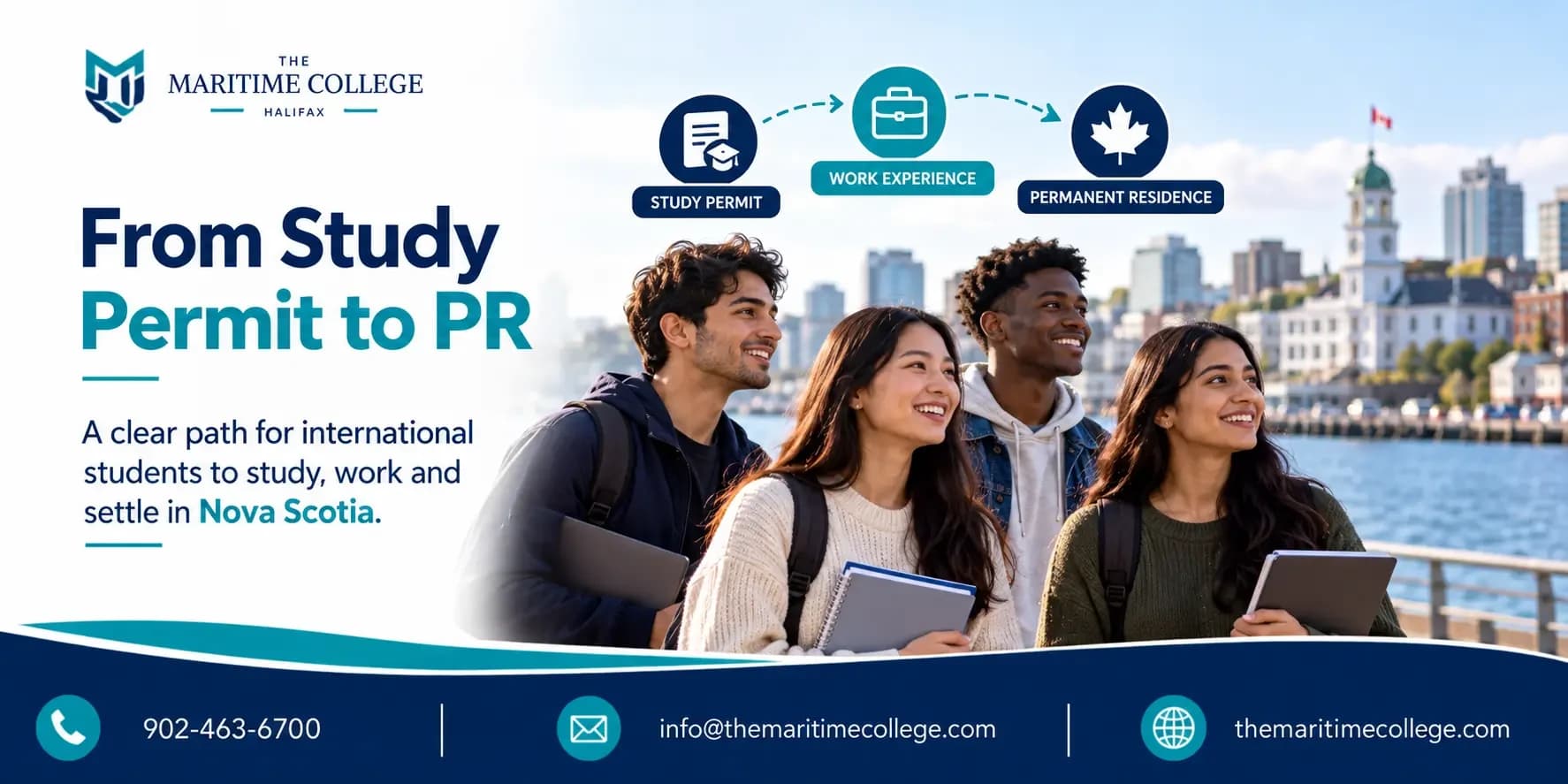
Most international students in Nova Scotia reach permanent residence in three stages. They study at an eligible institution, gain Canadian work experience, then apply through a federal or provincial immigration program.
Each stage has its own eligibility gate. Missing an early gate can close the later ones, even if you do everything else right.
- Study. You hold a study permit and attend a designated learning institution (DLI).
- Work. After graduation, most students work in Canada on a Post-Graduation Work Permit.
- Apply. You apply for permanent residence through a program such as the Atlantic Immigration Program, the Nova Scotia Nominee Program or Express Entry.
A study permit on its own never guarantees permanent residence. Immigration, Refugees and Citizenship Canada (IRCC) is the only body that issues permits and permanent resident visas. Nova Scotia can nominate or endorse candidates, but the final decision rests with the federal government.
What a Canadian Study Permit Allows International Students to Do
A Canadian study permit lets an international student study at a designated learning institution for the length of their program. A study permit is temporary status; it does not lead to permanent residence.
Most new applicants also need a Provincial Attestation Letter from the province where they will study, as Canada now limits how many study permits it issues each year. Rules and exemptions change, so always check the current requirements on IRCC's study permit pages before you apply.
How Designated Learning Institution Status Affects a Study Permit
A designated learning institution is an education provider approved by a province or territory to enrol international students. DLI status lets a school support study permit applications, but it does not mean the school's programs automatically qualify for a Post-Graduation Work Permit.
This is the single most common misunderstanding we hear from applicants. IRCC's designated learning institutions list shows separately which schools offer PGWP-eligible programs. A school can appear on the DLI list and still offer no PGWP-eligible programs at all.
Work Rules for International Students While Studying in Nova Scotia
Eligible full-time students can work off campus up to 24 hours a week during academic terms and unlimited hours during scheduled breaks. Not every study permit holder qualifies, so check the conditions printed on your permit.
According to IRCC's off-campus work rules, you generally must:
- study full time at a designated learning institution
- be in a post-secondary academic, vocational or professional program of at least six months that leads to a degree, diploma or certificate
- hold a study permit that authorizes off-campus work
- have a social insurance number
Students in English or French language programs only, or in general interest courses, cannot work off campus.
Post-Graduation Work Permit Rules for Nova Scotia Graduates
A Post-Graduation Work Permit is an open work permit that lets eligible graduates gain the Canadian work experience most permanent residence programs require. Eligibility depends on the school, the program, the field of study and language test results.
An open work permit means graduates can work for almost any employer in Canada. Each person can receive only one PGWP in their lifetime, and graduates must apply within 180 days of confirming they completed their program, according to IRCC's PGWP eligibility page. The program itself must be at least eight months long.
The PGWP matters because it is how most students build the work history needed for permanent residence. Without one, graduates usually need a different kind of work permit, such as one supported by an employer, before they can gain that experience.
Which Nova Scotia Institutions Offer PGWP-Eligible Programs
In Nova Scotia, PGWP-eligible programs are offered by institutions that IRCC lists as PGWP-eligible. In practice, these are mainly public universities and the public college system, along with degree programs at certain private institutions authorized to grant degrees.
| Usually qualifies for a PGWP | Does not qualify for a PGWP |
| Programs at public universities | Programs at private career colleges |
| Programs at public colleges | English or French as a second language programs |
| Degree programs at private institutions authorized to grant degrees | General interest or self-improvement courses |
| Programs completed more than 50% online |
School lists change, so the safest step is to search the IRCC list yourself rather than rely on any third-party summary, including this one.
Why Private Career College Programs Do Not Lead to a PGWP
Graduates of private career college diploma programs are not eligible for a PGWP. IRCC only issues a PGWP to graduates of a PGWP-eligible institution, and private career colleges do not hold that status.
The Maritime College is a private career college registered under Nova Scotia's Private Career Colleges Act. Our diploma programs are designed to prepare students for specific jobs in Canada. They are not a route to a PGWP, and we tell every international applicant this before they apply.
Other provinces say the same thing plainly. British Columbia's private training regulator, for example, warns students that graduates of private training institutions are not eligible for the PGWP.
IRCC also closed a former workaround. Programs where a private college delivers a public college's curriculum under a licensing agreement are no longer PGWP-eligible for most students who started after May 15, 2024.
PGWP Field of Study and Language Rules for College Graduates
College diploma graduates applying for a PGWP must have studied in an eligible field and show language ability at Canadian Language Benchmark (CLB) 5. University degree graduates are exempt from the field of study rule but need CLB 7.
| Rule | College diploma or certificate | University degree |
| Field of study requirement | Must be an eligible field (study permit applied for on or after November 1, 2024) | Not required |
| Minimum language level | CLB 5 in all four skills | CLB 7 in all four skills |
| Minimum program length | 8 months | 8 months |
IRCC publishes the eligible fields using program classification codes. Ask any public college for the code of the exact program you plan to take, then compare it with the list on the IRCC eligibility page.
Permanent Residence Pathways for International Graduates in Nova Scotia
Nova Scotia graduates usually apply for permanent residence through the Atlantic Immigration Program, the Nova Scotia Nominee Program or federal Express Entry. Each pathway sets its own rules for education, work experience and job offers.
| Pathway | Institution rule | Job offer needed? | Work experience needed? | Key deadline |
| Atlantic Immigration Program (graduate route) | Publicly funded Atlantic institution, program of 2+ years | Yes, from a designated employer | No | Apply within 24 months of graduating |
| NSNP Nova Scotia Graduate stream | Eligible Nova Scotia DLI, program of 30+ weeks in one of four occupations | Yes, permanent and full time | No | Studies completed within 3 years |
| Express Entry (Canadian Experience Class) | No institution rule | No | 1 year skilled Canadian work | Work within the last 3 years |
Atlantic Immigration Program Requirements for International Graduates
The Atlantic Immigration Program graduate route needs a credential from a recognized, publicly funded institution in an Atlantic province and a job offer from a designated employer. Graduates do not need work experience, but they must apply within 24 months of graduating.
According to IRCC's AIP assessment guidelines, the graduate must also:
- complete a program of at least two years as a full-time student
- have lived in an Atlantic province for at least 16 of the last 24 months before graduating
- not have taken more than half of the program by distance learning or as language training
Because the credential must come from a publicly funded institution, graduates of private career colleges cannot use this route. The Atlantic Immigration Program also has a skilled worker route, which needs qualifying work experience instead.
Nova Scotia Graduate Stream Requirements Under the NSNP
The Nova Scotia Graduate stream is open only to recent graduates with a permanent, full-time job offer in one of four occupations. Studies must be completed within the last three years at an eligible Nova Scotia designated learning institution.
The four occupations listed in the Nova Scotia Graduate stream guide (September 2026) are:
- paramedical occupations (NOC 32102)
- pharmacy technicians (NOC 32124)
- nurse aides, orderlies and patient service associates (NOC 33102)
- early childhood educators and assistants (NOC 42202)
Applicants also need a program of at least 30 weeks (24 weeks for nurse aides), at least half of it completed while living in Nova Scotia, and CLB 5 language ability. Submitting an expression of interest is free, but candidates selected for processing pay a non-refundable $1,000 fee. Selection is never guaranteed. The current occupation list is on the Nova Scotia Graduate stream page.
None of The Maritime College's current programs prepare students for these four occupations.
Canadian Experience Class and the Nova Scotia Express Entry Stream
Graduates with at least one year of skilled Canadian work experience can enter the federal Express Entry pool through the Canadian Experience Class. Nova Scotia can then invite selected candidates through its Nova Scotia: Express Entry stream.
The Canadian Experience Class requires 12 months of full-time work (or 1,560 hours) in a TEER 0, 1, 2 or 3 job within the last three years. Work done while you were a full-time student does not count. For most graduates, that year of experience comes from working on a PGWP.
Nova Scotia selects Express Entry candidates according to its labour market priorities, which change during the year. Check Live in Nova Scotia's graduate guidance for current priorities.
Benefits of Planning PR Eligibility Before Enrolling in Nova Scotia
Checking permanent residence eligibility before enrolling protects your tuition, your time and your future options. It lets you pick a program that matches your real goal, whether that goal is permanent residence, job-ready skills or both.
Students who check first can:
- avoid paying for a program that cannot lead to a PGWP, which is the most expensive mistake we see
- match their studies to occupations Nova Scotia is actively recruiting
- plan ahead for time limits, such as the 24-month AIP window and the 3-year Nova Scotia Graduate window
- choose confidently between a longer public program built for immigration and a shorter, career-focused diploma, based on their status
Who a Private Career College Diploma in Nova Scotia Suits Best
A private career college diploma in Nova Scotia suits learners who already have the right to live and work in Canada and want job-ready skills quickly. Permanent residents, protected persons and some open work permit holders often benefit most.
At The Maritime College, our programs run from 44 to 80 weeks. That is shorter than many academic routes, which matters for people who need to start earning soon. Students learn on campus in Halifax with instructors who work in, or have worked in, the fields they teach.
Our current diploma programs are:
- Paralegal (60 weeks)
- Veterinary Assistant (44 weeks)
- Interior Decorating (56 weeks)
- Counselling Skills / Social Human Services (55 weeks)
- Business Office Administrative Assistant (55 weeks)
- 2D/3D Animation and Digital Arts (80 weeks)
Graduates often tell us the practical focus is what made the difference. Wayne MacEachern, a Counselling Skills / Social Human Services graduate, described his program as taught by people who know the industry and share the tools needed to go directly into the field.
Our college also has an articulation arrangement with Yorkville University, which can help graduates who later want to continue toward a degree. This agreement means that you can transfer your academic credit from The Maritime College to the Yorkville University, reducing the total number of modules you need to study to get a degree.
How to Verify a Nova Scotia College's DLI and PGWP Status
To verify a college, search for it on IRCC's designated learning institutions list and check whether it offers PGWP-eligible programs. For a college diploma, also confirm that the program's field of study appears on IRCC's eligible list.
Follow these steps before paying any deposit:
- Open the IRCC designated learning institutions list and filter by Nova Scotia.
- Search for the college by name and note its DLI number.
- Check whether the college appears in the PGWP-eligible table, and review its list of eligible programs.
- Ask the college, in writing, for the classification code of your exact program.
- Compare that code with the eligible fields on the IRCC PGWP eligibility page.
- Confirm the program is mostly in person, since programs more than half online do not qualify.
If a college website and the IRCC list disagree, trust the IRCC list. Ask the college to explain the difference in writing before you pay anything.
Common PR Planning Mistakes International Students Make in Nova Scotia
The most costly mistakes are assuming every DLI offers PGWP-eligible programs, choosing a program outside the eligible fields, and missing application deadlines. Relying on unlicensed agents causes many of the other problems.
| Mistake | Why it matters | How to avoid it |
| Assuming DLI status means PGWP eligibility | Many DLIs, including private career colleges, offer no PGWP-eligible programs | Check the PGWP table on IRCC's DLI list |
| Choosing a college program outside the eligible fields | No PGWP after graduation, even from a public college | Confirm the program's classification code first |
| Counting part-time student work toward Express Entry | Work done as a full-time student does not count for the Canadian Experience Class | Plan to gain experience after graduation |
| Missing the PGWP or AIP deadline | PGWP applications are due within 180 days; AIP within 24 months | Mark both dates when you finish your program |
| Taking most of a program online | Programs more than half online do not qualify for a PGWP | Choose in-person or mostly in-person study |
| Trusting an unlicensed agent | Unauthorized representatives cannot be held accountable for bad advice | Use a licensed consultant or lawyer |
Where International Students Can Get Licensed Immigration Advice
Only licensed Regulated Canadian Immigration Consultants, lawyers, and Quebec notaries can charge for immigration advice in Canada. Students can confirm a consultant's licence on the College of Immigration and Citizenship Consultants public register.
Nova Scotia's own immigration guide warns that it does not work with unauthorized representatives. If an unlicensed person gives you wrong advice, you may have no way to hold them accountable.
Free help is also available. In Halifax, the Immigrant Services Association of Nova Scotia (ISANS) offers settlement and employment support to newcomers.
Colleges, including The Maritime College, can explain their programs, admission steps and study conditions. College admissions teams are not licensed to give immigration advice, and you should be cautious of any school that promises a visa or permanent residence outcome.
Frequently Asked Questions About Studying in Nova Scotia and PR
Can my spouse work in Canada while I study at a college in Nova Scotia?
Since January 21, 2025, spouses of college and most undergraduate students are no longer eligible for a family open work permit. According to IRCC's notice, the permit is mainly limited to spouses of students in master's programs of 16 months or longer, doctoral programs, and select professional programs.
Is The Maritime College a designated learning institution?
Yes, The Maritime College is a designated learning institute, with DLI number O19391557015. The Maritime College is a private career college in Halifax, Nova Scotia. So, its diploma programs are not eligible for a Post-Graduation Work Permit.
Can I study at The Maritime College first and transfer to a public college later?
Students can apply to a public college after finishing a private career college program, but each admission and study permit decision is separate. Only the program at the PGWP-eligible institution would count toward a PGWP, so the transfer needs careful planning and a fresh eligibility check.
Does a diploma from a Nova Scotia college help in Express Entry?
A Canadian diploma can earn education points in Express Entry, and Canadian credentials do not need a separate foreign credential assessment. Candidates still need at least one year of qualifying skilled work experience to enter the Canadian Experience Class.
Does The Maritime College offer immigration advice?
No. The Maritime College admissions team can explain programs, admission requirements and study documents, but the college does not give immigration advice. For advice on your situation, contact a licensed immigration consultant or lawyer.
Next Steps for International Students Planning a Future in Nova Scotia
Permanent residence after studying in Nova Scotia is possible, but it depends on choosing an institution and program that qualify for a Post-Graduation Work Permit. The Atlantic Immigration Program graduate route requires a publicly funded Atlantic institution, and the Nova Scotia Graduate stream is limited to four occupations. Express Entry rewards skilled work gained after graduation, not during studies.
Before you pay any deposit, check the school on IRCC's official lists, confirm your program's field of study, and speak with a licensed immigration professional if permanent residence is your main goal. If you already have permanent residence or permission to work in Canada, a shorter career diploma may be the fastest way to build a Canadian career.
If that second path sounds like yours, our team would be glad to help. Book a free admissions call, explore our diploma programs, or visit our International Students page to learn how admissions work at The Maritime College.